One line, and it never stops.
This is the whole of how a Ljusverk shade is made, in the order it happens. There is no assembly step at the end because there is nothing to assemble.
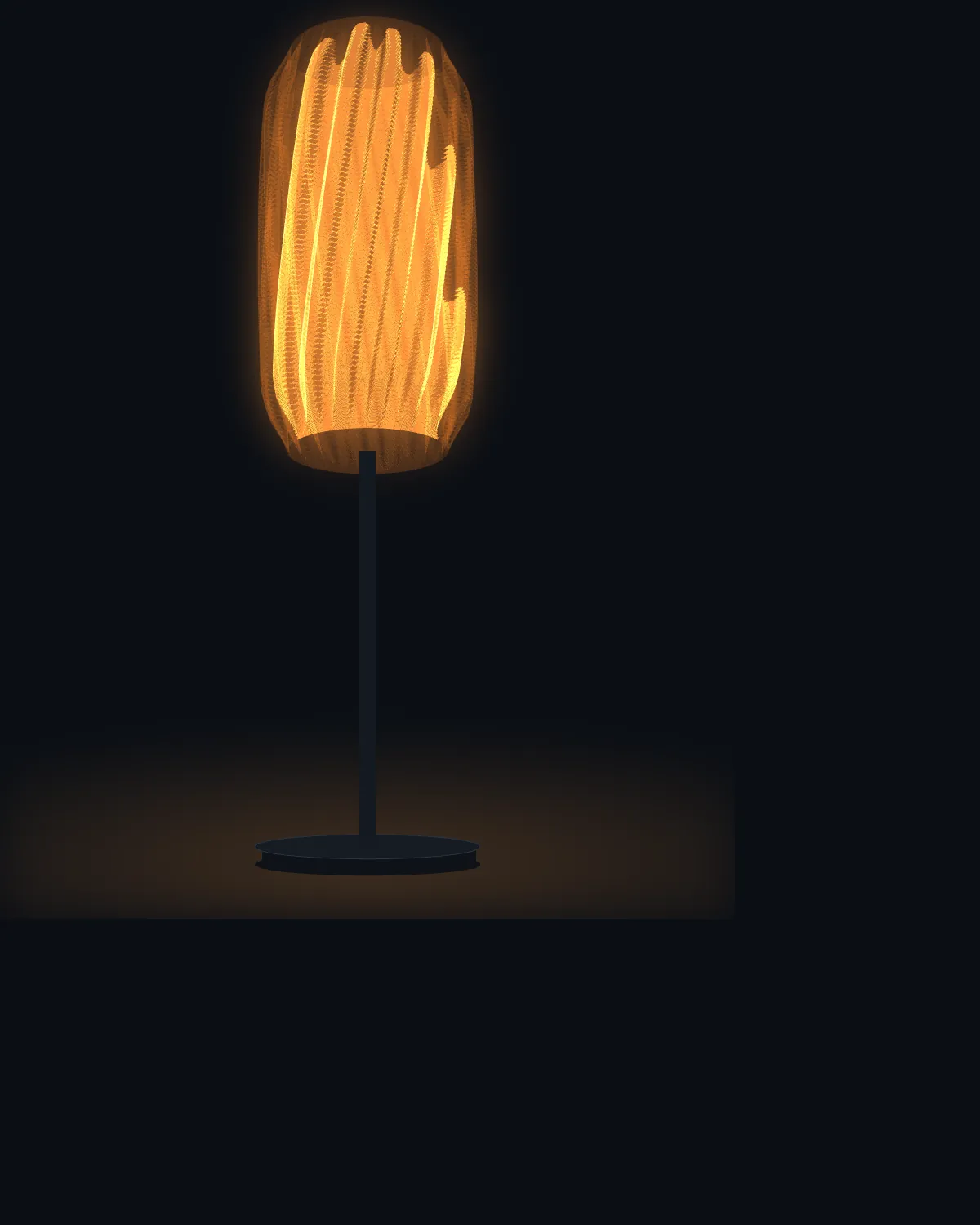
Drawn from the same numbers
This is TJÄLE — 3 076 metres, 2 214 layers, sixteen square-shouldered flutes on a slow twist. Follow the spiral, shown as a layered drawing. The changing density of the lines lets you see how the flutes overlap as the shade turns.
Drag it to turn it. The dial in the header dims it, and takes it from 2700 K down to 1800 K on the way, which is what the LK‑9 does.
Fourteen hours, in six parts
-
Z 0.00 mm
The purge line
Every print starts with a 180 mm line laid down at the front of the plate that is not part of the object. It gets the pressure up and it tells the operator, in one glance, whether the material is dry. A purge line with a rough edge means the granulate has taken water out of the air overnight and the batch goes back to the dryer.
-
Z 0.28 mm
The first layer
One closed contour, laid at 40 % of normal speed on to a plate at 62 °C. This is the only layer that touches the machine, and it is the only one that can fail quietly — a shade that lifts a millimetre at the edge finishes eight hours later, out of round, and looks perfect until you set it down.
-
Z 0.28 → h
The helix
From here the head does not stop. Z climbs by exactly one layer height over each revolution, so what is printed is not a stack of rings but a single helix. Nothing retracts, nothing travels, and there is no seam anywhere in the wall because there is nowhere for one to be.
-
the Z‑seam
The one place it steps
A spiral has to step up somewhere, and that step is the Z‑seam: a 0.28 mm ramp that runs the height of the shade. Most printers hide it behind a corner. We twist it — 0.16° per millimetre on SPIRA — so it walks around the object and reads as a slow helical line of light instead of a scar down one side.
-
cooling
Two fans, and patience
A 0.8 mm wall at 0.28 mm layers is laying material on to material that is 1.4 seconds old. Too much cooling and the layers do not weld; too little and the flutes slump. The chamber runs at 38 °C and the part fans at 55 %, and both numbers were found by breaking about forty shades.
-
the rim
The last revolution
The flutes fade out over the final six per cent of the height so the rim closes as a clean circle, and the flow tapers to zero over the last 40 mm. Then the head lifts and the shade is finished: no join, no glue, no fasteners, and nothing to take apart.