62% · 2358 K
Mörkret

Four hours and fifteen minutes.

That is all the daylight there is at Sävar on 21 December, and it is the reason this company exists here rather than somewhere with a better airport. Below is the whole year, computed rather than drawn.

365 days at 63.9° north. Daylight pale, blå timmen — civil twilight, sun between 0 and −6° — blue, and everything below that dark. From the solar hour angle with the sun's disc and refraction taken at −0.833°, which is the same convention an almanac uses. Drag across it, or use the arrow keys. The dark warms as you turn the dial up, because that is the part of the year the lamp is on.
DateDaylightBlå timmenDark
21 December5 h 55 m2 h 07 m15 h 58 m
1 February6 h 58 m1 h 55 m15 h 07 m
21 March12 h 07 m1 h 35 m10 h 18 m
1 May16 h 40 m2 h 14 m5 h 06 m
21 June20 h 57 m3 h 03 m0 h 00 m
1 August17 h 53 m2 h 53 m3 h 14 m
23 September12 h 00 m1 h 34 m10 h 25 m
1 November7 h 48 m1 h 47 m14 h 25 m

What the numbers do to a room

A house at this latitude has two lighting problems and they are opposites. From November to February the artificial light is not supplementing daylight, it is replacing it, for sixteen to twenty hours a day — so it has to be good enough to live under, not just to see by. That is where Ra 97 stops being a specification and starts being the difference between a room and a corridor.

Then in June it never gets dark at all. Civil twilight at Sävar runs from sunset straight into sunrise from about 25 May to 18 July: the sun dips below the horizon and the sky stays lit. Half of what people here buy blackout curtains for, the other half of the year, is the problem this company is named after.

Mörkertid is the ordinary word for it. It is not poetic and nobody says it with any drama; it is just the half of the year you plan around.

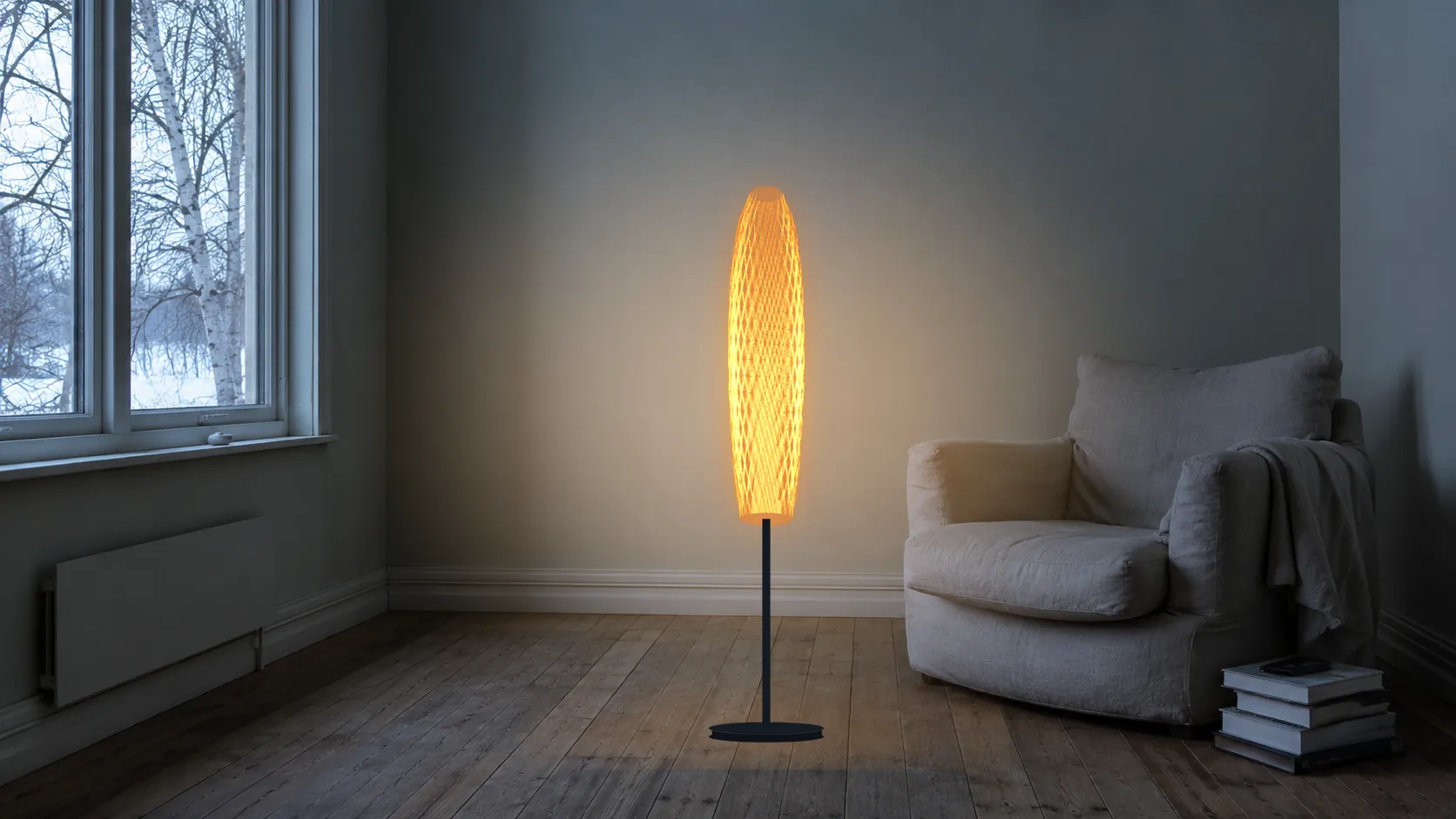
A Umeå flat at three in the afternoon in December, lit by a SPIRA floor lamp
Haga, Umeå. 15:04, 14 December — forty minutes after sunset.

Designed where it is used

Almost every lamp sold in Europe is drawn somewhere with a Mediterranean relationship to light, where the fitting is an object you look at in daylight and switch on for atmosphere. Here it is the other way round: the lamp is on before you get home and it is still on when you go to bed, and what you are looking at for four months is the fitting, lit, from three metres away.

That is why the flutes are as deep as they are, and why nothing we make is a smooth white globe. A lit surface with structure in it stays interesting for a season. A lit surface without any goes flat in a week and then it is just a bright spot in the corner of your eye.

The ten forms